Seeing red: why do all these beetles look like each other?

From: “Persistence of multiple patterns and intraspecific polymorphism in multi-species Müllerian communities of net-winged beetles”, M. Bocek, D. Kusy, M. Motyka and L. Bocak (2019). Frontiers in Zoology 16:38

https://frontiersinzoology.biomedcentral.com/articles/10.1186/s12983-019-0335-8

We’ve all seen warning colouration – the stripes on bees and wasps, the bright hues of snakes and the colourful spots of tropical frogs all serve a single purpose, and that purpose is to send out a message to predators saying ‘don’t even bother trying to eat me’. The principle of aposematism – warning colours – entered western science in 1867, when Alfred Russel Wallace was grappling with why so many caterpillars have bright colours. He reasoned that some caterpillars must be distasteful to birds, but this in itself would not protect a caterpillar from being attacked if the bird didn’t immediately recognise that the caterpillar was no good to eat. The bird would need a signal it could easily spot, as even a slight injury to the caterpillar could be either fatal or very costly. He therefore suggested that the purpose of the bright colours of many caterpillars was to send a clear signal to birds not to eat them.*

 Much further work in this area was done by Henry Walter Bates (who was present at the 1867 meeting where Wallace outlined his theory) and Fritz Müller, both of whom outlined important consequences of warning colours. Bates noticed that if a toxic or distasteful species lived alongside perfectly harmless ones, the harmless ones would often evolve to look like the dangerous ones. The famous example is in North American snakes – several harmless snakes resemble venomous species – but probably the most interesting example to look up is clearwing moths, many of which have an uncanny resemblance to wasps. As predators learn to recognise the markings of dangerous animals, they will assume that anything with similar markings is also dangerous, so harmless species gain protection from looking like dangerous ones. This is known as Batesian Mimicry, and it’s why hoverflies look like wasps.**

But the sort of warning colouration mimicry that Müller discovered, and Matej Bocek’s team were looking into, is just as interesting. Like most researchers looking into aposematism and mimicry, Müller studied tropical butterflies. He noticed that the toxic butterflies he studied all had very similar patterns – they mimicked each other, as well as being mimicked by harmless species. This makes perfect sense: if, for the sake of example, one toxic species has a bold red stripe across the forewing then predators will avoid anything with that stripe. So if another toxic butterfly has that stripe, it stands an advantage, as it will have a much lower chance of being eaten by predators that haven’t learned that red stripe=not tasty. The more toxic individuals across many species look like each other, the less chance they have of being eaten by a predator who hasn’t yet learned to avoid them. This is Müllerian Mimicry, and it’s why so many different species of wasps and bees all have black, yellow and orange stripes.

As I mentioned, most of the work in this area has been done on butterflies. Bocek’s team therefore decided to look at Müllerian Mimicry in a much more overlooked group of net-winged beetles, the genus Eniclases. Eniclases are known to be ‘unprofitable’ prey for predators, and have previously been shown to have their bright red, black, orange and yellow colours for warning, but have not otherwise been studied very much. The researchers collected 1,914 individual beetles from across New Guinea, catalogued their patterns, and took mitochondrial DNA (mtDNA – the sort that you only inherit from your mother) samples to work out how closely related the different species of Eniclases were.
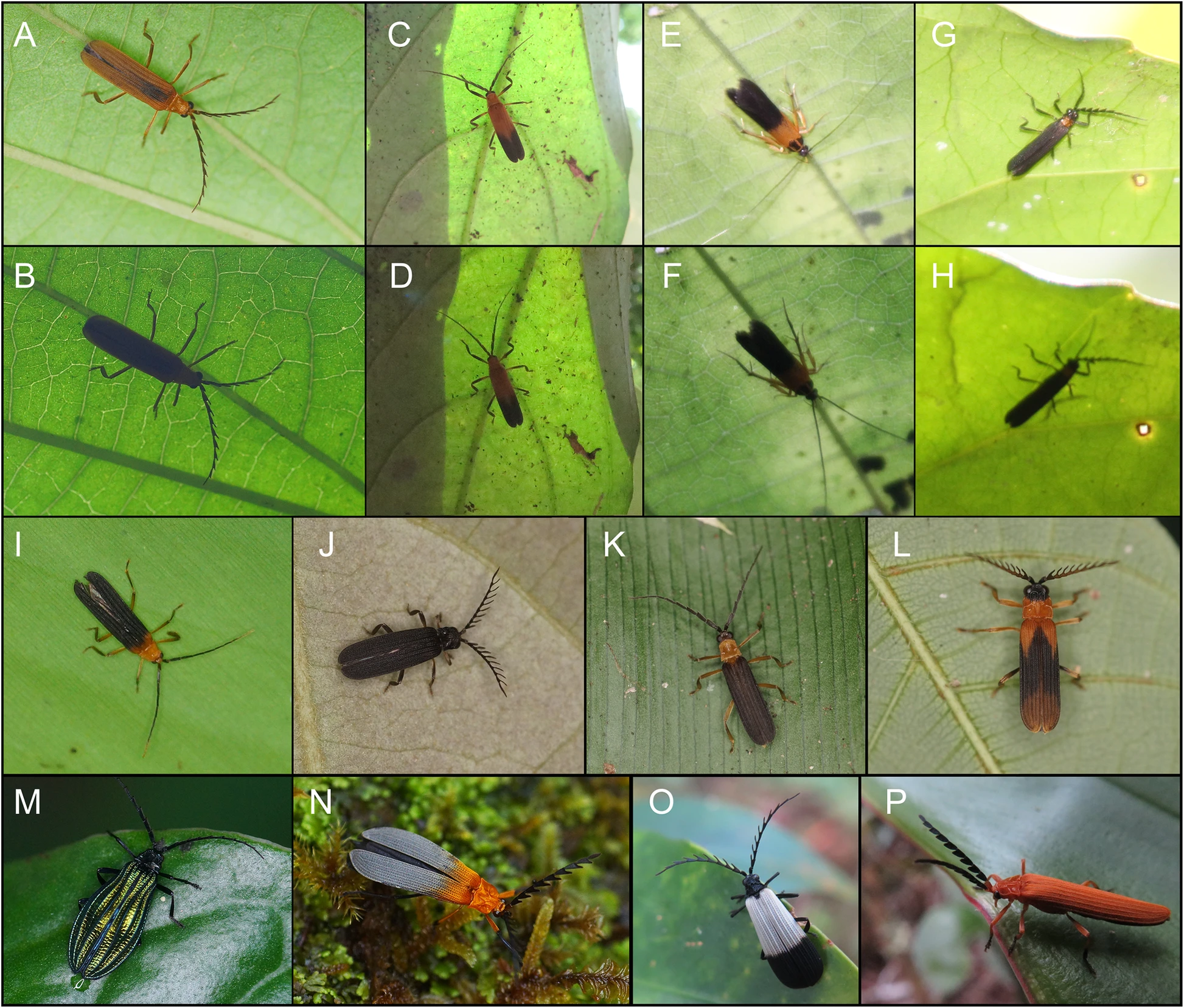
Müllerian Mimicry in net-winged beetles. Only A and B are Eniclases species, but it’s obvious how much these beetles are mimicking each other, and all gain protection from having similar patterns. The top two rows are the same photo taken with and without flash.

They found that Eniclases species which looked very similar, and had similar patterns, were often not all that closely related, and that the more closely related species quite often had different patterns from each other. This is a pretty strong indication that Eniclases are Müllerian mimics: why would closely related species evolve in different directions and both end up looking like other, equally distasteful, species if not to take advantage of the protection offered by Müllerian Mimicry? Intriguingly, this doesn’t stop at species level – several species come in different colour forms, which resemble only very distantly related species. Presumably this means that the species can live in a greater variety of areas – it will be protected by its colours in any place where any one of its ‘co-mimics’ live.

The scientists also raise another interesting possibility: what if warning signals, and Müllerian Mimicry, aren’t confined only to colour? They noticed that Eniclases beetles like to sit on the underside of leaves, where their colour won’t be obvious to a bird or other predator looking at them from above – but their shape will be. The researchers speculated that this might be one reason why Eniclases species are all basically the same shape; if the shape of a toxic beetle is recognisable to predators, it would be advantageous to keep that shape. Even more tantalisingly, they suggest that this could explain why many mimics aren’t quite as similar in colour as they might be. If shape is also important, perhaps a beetle could get away with not having exactly the same colours as a toxic beetle the predator has already encountered because it is the same shape. Maybe the bird recognises a toxic shape as well as a toxic pattern, allowing beetles with imperfect mimicking patterns to escape.

More research is, as ever, needed, but this is a very intriguing suggestion. I’m looking forward to seeing how well this theory stands up to experiment.

* March 4th 1867, “Proceedings for the Year 1867”, Transactions of the Royal Entomological Society 15:7. Apologies for the historical detour, this is an area I did some research in a few years ago.

**More recent research has demonstrated that this only works if predators are more likely to encounter dangerous animals than harmless ones – otherwise they will learn to ignore the danger markings. There’s some great science about balancing selection across species and the population genetics of this phenomenon, which I would highly recommend looking into.

If you find an error or lack of clarity in this piece, please contact me on j.d.r1612@gmail.com and I’ll fix it as soon as I can.

The eyes have it: the weird and wonderful evolution of eyes in a mollusc

From: “Remnants of ancestral larval eyes in an eyeless mollusk? Molecular characterization of photoreceptors in the scaphopod Antalis entails”, T. Wollesen, C. McDougall and D. Arendt (2019), EvoDevo 10:25

https://evodevojournal.biomedcentral.com/articles/10.1186/s13227-019-0140-7

The evolution of eyes in molluscs is a particularly complex and interesting puzzle in evolutionary biology. No other group has the sheer variety of different eyes. Octopuses* have a camera eye somewhat like our own, nautiluses** make use of a pinhole eye, snails have the familiar ‘cup eye’, scallops have mirror-based eyes and ark clams even have compound eyes not dissimilar to those of insects. Some molluscs even have no eyes at all!

At one level, this is not too surprising – molluscs are incredibly diverse generally. From an ancestor which (we think) was basically a foot, a feeding implement called a radula, and a shell, they have created an incredible variety of forms. The foot has become tentacles (in cephalopods), the radula has become a beak (in squids), the shell has split in two and enveloped the animal (bivalves), become curled round into a spiral (snails), and even been lost all together (slugs, octopuses). On the face of it, it makes sense that a group diverse enough to include squids, scallops and snails should include a variety of different arrangements for seeing. But how exactly did this come about?

What the ancestral mollusc is speculated to have looked like. Based on my notes from the first year of my undergraduate degree

Tim Wollesesn, Carmel McDougall and Detlev Arendt had an idea to find out more information. They looked an eyeless marine mollusc Antalis entalis. Antalis belongs to a clade*** known as the scaphopods. Within molluscs, scaphopods are thought to be most closely related to gastropods (snails, slugs and such), and then, slightly more distantly, to bivalves. The researchers looked at which genes were expressed (activated) when and where during the development of Antalis entalis. At this point it should be noted that Antalis, like many other molluscs and worms, goes through a planktonic larval stage of development called a trochophore. Trochophores are very useful for animals such as clams, worms and scaphopods which cannot move very far. The trochophores are able to float around in the ocean as they grow, eventually settling down somewhere suitable for a slower pace of life. This allows the animal to colonise new areas, reduce overcrowding and maintain genetic diversity – all very useful things!

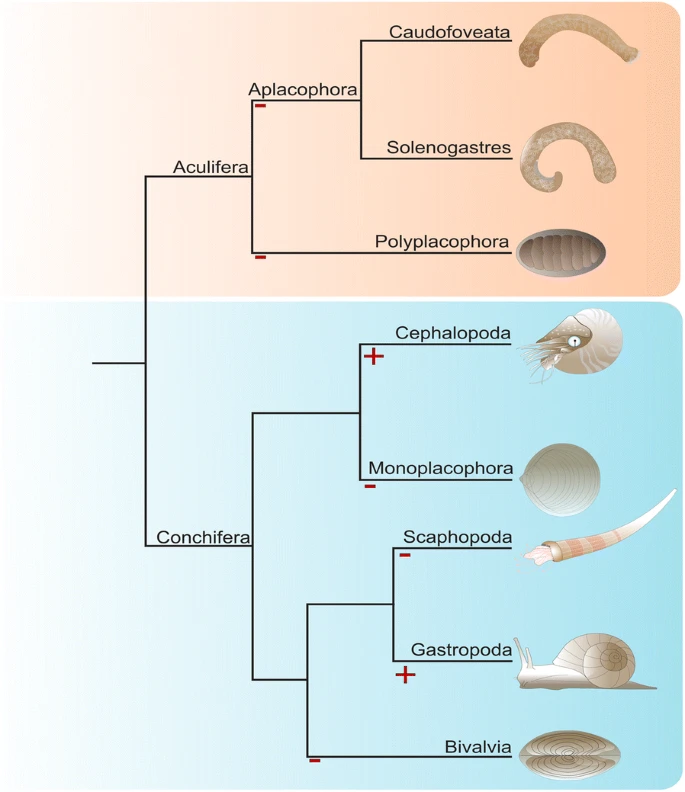
Phylogram (family tree) of molluscs, marked + where eyes are present on the head of the adult, and – where they are not. Taken from Wollensen, McDougall and Arendt, 2019

They detected a range of genes which look like opsins. Ospins are genes which encode photopigments necessary for any kind of light detection. As such, they are very old, and found across a wide range of animals. But why would an animal with no eyes have these genes activated? And why were they activated in special cells on the edges of the trochophore? In every species so far studied, every opsin is linked by a lysine amino acid unit to a chromophore, forming a pigment which will react to light. The fact that this lysine appears in such a huge variety of animals suggests that it is if not essential, certainly very very important. It appears that Antalis entalis does not have this lysine. While it has been shown that it is possible to detect light with a slightly differently arranged opsin, the scientists could not find any sign that the necessary mutations had occurred in Antalis entalis. However, this does not mean that the cells containing opsins in Antalis entalis are useless. In fact, they are shaped remarkably like chemoreceptors. Chemoreceptors exist to detect different chemicals. They are particularly useful in water, but we have hundreds of them on our tongue and nose, mostly used to detect whether food is good to eat. Other animals, such as dogs, have many more, and use them for tracking food and recognising each other. The possible chemoreceptors in Antalis entalis did not see any activity in some genes thought to be essential for detecting light, either and Antalis has also lost the shading mechanisms needed to tell which direction light is coming from. This led the researchers to suggest that these cells evolved from photoreceptors, and were re-purposed to sense something else, probably a chemical of some sort.

The ancestors of this scaphopod, it seems, had eyes, or at least eyespots which could detect light. The story gets even stranger. The repurposed light-detecting cells (photoreceptors) of Antalis entalis look very similar to the eyes of the polyplacophoran trochophore. The polyplacorphora are also molluscs, which, in their adult form, are eyeless and lack the single shells of the more familiar molluscs, instead having a segmented shell. As you might guess, they are only distantly related to scaphopods. This suggests that the ancestral mollusc had some form of photoreceptor, which some of its descendants lost. This at least, gives some kind of indication of how the incredible variety of eyes could evolve in molluscs – perhaps they all started from a fairly simple sort of eyespot, and diversified from there.

So, it appears, while other molluscs were developing all kinds of crazy eyes, the ancestors of Antalis entalis were repurposing theirs for something altogether different. There’s very few things so unexpected they haven’t evolved somehow.

*Or possibly Octopi

**Nautili?

***clade – a group of organisms all descended from a single common ancestor. A very useful term because it can include anything from all animals to all individuals of a single subspecies.

If you find an error or a lack of clarity in this article, please contact me on j.d.r1612@gmail.com, and I’ll fix it as soon as I can

All the small things: how good teamwork can make a big difference

From: “The division of labour between community medicine distributors influences the reach of mass drug administration: A cross-sectional study in rural Uganda”, G.F. Chami, N.B. Kabatereine, E.M. Tukahebwa (2019), PLos Neglected Tropical Diseases 13:9

https://doi.org/10.1371/journal.pntd.0007685

One under-celebrated area in medical studies is working out how best to get drugs and vaccines to at-risk communities. You can have all the prize-winning drugs and treatments in the world, but if you can’t administer them to patients, it doesn’t mean much. For several tropical diseases, especially those caused by parasitic worms, the favoured approach amongst those working in public health is Mass Drug Administration (MDA). This is where a drug is given to as many people as possible in order both as prevention and cure (especially where people may not be aware they’re hosting a parasite). Ideally, as well as curing and protecting people, it also interrupts the local transmission cycle of the disease, ensuring people are less likely to come into contact with it in future. If you kill worms before they are able to lay eggs, the eggs won’t be able to infect other people.

Though often very effective, this approach has its challenges, particularly in areas where the population is quite sparsely spread around and transport links may not be the fastest. A common approach in these circumstances is to give the drugs to local volunteers who are tasked with administering them to people in their own village and surrounding areas. To try to find ways to optimise MDA using volunteers, Goylette Chami, Narcis Kabatereine and Edridah Tukahbwa collected information on volunteers administering anthelmintics (anti-worm drugs) across 28 villages in Mayuge District, south-east Uganda. These are mostly fishing villages along the shores of Lake Victoria, and many have a real problem with a particularly nasty parasitic worm called Schistosoma mansoni*, and lesser problems with other worms such as hookworm and those that cause lymphatic filariasis. They assessed a number of different factors regarding the volunteers, who worked in pairs, including personal attributes and how close the two were.

What they found was interesting. Much of the time, one half of a given volunteer pair would shoulder a disproportionate amount of the workload. Though this was very variable, the scientists calculated that, on average, one volunteer would treat only a third as many people or households as their counterpart. This seems to have led to some problems – only a little under half of eligible people received any drugs at all, and only a quarter got all three of the recommended anthelmintic drugs. Some villages did better than others – 3 of the 28 achieved the World Health Organisation-recommended treatment rates for schistosomiasis (caused by Schistosoma), hookworm and lymphatic filariasis.

The scientists found that the best predictor, the single factor that seemed to have the biggest impact on how many people received the drugs, was the division of labour between the volunteers. The more equally the work was distributed, the more people received treatment. Oddly enough, the researchers found that volunteers who were close friends tended to divide the work more equally, but that close friendship between the two did not seem to directly affect how many people they treated. There is currently no guidance given to volunteers on how to split their work, and only a single annual meeting of volunteers for training, so the authors suggest that it might be worth improving both of these to ensure everyone gets the treatments they are entitled to, but there is not currently enough evidence to be sure either would work. Either way, this study offers a relatively quick-and-easy solution to improving lives for large numbers of people.

This is a neat little study into a sometimes overlooked area, which nicely demonstrates how sometimes it can be the little things, like how well people work together, that can make a big impact on global problems.

*A major issue in many fishing areas, as it lives in water and uses lake snails as an ‘intermediate host’ – for more information see https://www.who.int/news-room/fact-sheets/detail/schistosomiasis

If you find an error or lack of clarity in this article, please contact me on j.d.r1612@gmail.com and I’ll fix it as soon as I can

Plant oils: the future of food preservation?

From: “Insecticidal Activity of Four Plant Essential Oils against Two Stored Product Beetles”, K. Saeidi and H. Pezhman (2018), Entomology, Ornithology & Herpetology 7:3

https://doi.org/10.4172/2161-0983.1000213

Storage pests are a real problem in feeding the planet, and can result in huge losses of stored crops that have taken many months to grow. Insects, especially beetles such as Bruchus lentis and Callosobruchus maculatus, are a major cause of such losses. One of the most commonly used methods to prevent insects from destroying food stores is fumigating them by pumping them full of synthetic insecticides. This has its downsides, especially as there’s a limit to the amount of pesticides you can use on a food before people become unwilling to eat it.

Karim Saeidi and Hossein Pezhman are among those looking at plant oils as an alternative to traditional pesticides in protecting stored food. They therefore set out to discover how toxic the fumes from the oils of four plants were to the two beetles I mentioned earlier – Bruchus lentis, a lentil pest, and Callosobruchus maculatus, the cowpea beetle. The four plants they chose were all easy to obtain in their region of Iran – peppermint (Mentha piperita), pennyroyal (Mentha pulegium), shirazi thyme (Zataria multiflora), and another local thyme, Thymus daenensis.

But why test plant oils as insecticides in the first place? What made these scientists think that they might be useful in protecting food against insects? The first reason is logical – insects are a major threat to most species of plants, so it would be advantageous for most plants to have some sort of chemical defence. In many cases the insects actually evolve their own counter-defences against their food’s toxicity, often leading to ‘arms-races’ where the plants get more and more toxic and the insects get more and more resistant, right up to the point where there’s no more advantage to be gained from toxicity, and the plants start producing less toxin. This means that there is no longer much advantage, (and there’s usually a lot of disadvantages) in being resistant, so the insects lose their resistance and the cycle starts up again. For this reason, concentrations of insecticidal chemicals can vary massively between different populations of plants – each local population is at a different stage of the cycle. The genius of using plant oils on storage-pest insects is that they come from plants, and parts of the plants, that the pests, being adapted principally to eating seeds, would not normally eat. This means that they are unlikely to have any resistance to them. The researchers also point out that plant oils are unlikely to be harmful to humans, and may even be beneficial, which is a definite advantage.

Saeidi and Pezhman found that fumigating using any of their four oils could kill at least some of the beetles. But the different oils were differently toxic to the beetles. Peppermint was the most toxic oil: a dose of 14 microlitres* per litre of air was enough to kill every beetle after 72 hours of exposure. Oil from the thyme Thymus daenensis was also able to achieve this, but only at a much higher concentration – 80 microlitres (μL**) per litre of air. That is, it took over 5 times as much thyme oil to kill the same amount of beetles in the same time. Neither of the other plants was able to achieve this – at 80μL per litre of air, Zataria multiflora thyme killed all of the Bruchus lentis beetles but only 83% of the Callosobruchus maculatus. Similarly, pennyroyal only killed 85% of the B. lentis and 89% of the C. maculatus at 100μL per litre of air.

The researchers were also able to calculate a toxicity measure known as the LC50 – the concentration which kills 50% of a sample.*** The lower this figure is, the more toxic the substance is. So, the LC50 of peppermint for B. lentis was only 14.62μL per L of air, whereas that of pennyroyal for the same insect was 92.32μL per litre of air. Interestingly, the researcher’s calculations were not able to find any certain difference in the LC50s of pennyroyal and Thymus daenensis, but Zataria multiflorensis seems to be slightly more toxic than both on B. lentis. However, this does not seem to apply to C. maculatus. Peppermint oil was by far the most toxic to both species of beetle. But why? It’s not yet clear, but the active insecticidal compounds in peppermint are thought to be menthone and menthol, compared to thymol and 1,8-cinole in thyme. The researchers speculated that different species may have different concentrations of these chemicals, leading to their differing (and also not-differing) toxicity levels.

So – is peppermint oil fumigation the future of food preservation? Quite possibly, but is remains to be seen if it affects the taste of these foods.

*A microlitre is a millionth of a litre, so that’s 0.0000014 litres of peppermint oil per litre of air

** ‘μ’ is the Greek equivalent of ‘m’, and ‘mL’ was already taken by millilitres. I don’t make the rules.

*** so, Lethal Concentration 50

If you find an error or a lack of clarity in this piece, please contact me on j.d.r1612@gmail.com and I’ll fix it as soon as I am able

Evolving from harmless filter-feeder to venomous predator: the strange history of the Viper Copepods

From: “Evolutionary transformation of mouthparts from particle-feeding to piercing carnivory in Viper copepods: Review and 3D analyses of a key innovation using advanced imaging techniques”, T. Kaji, C. Song, K. Murata, S. Nonaka, K. Ogawa, Y. Kondo, S. Ohtsuka and A.R. Palmer (2019), Frontiers in Zoology 16:35

https://frontiersinzoology.biomedcentral.com/articles/10.1186/s12983-019-0308-y

Evolution is generally thought to be a gradual, incremental process, gradually reshaping organisms over long periods of time. While this is accurate, over large scales, evolution has a tendency to move in fits and starts: a ‘key innovation’ evolves which allows a group of organisms to rapidly diversify to suit a large number of lifestyles appears, and suddenly a single species is three dozen, all with their own specialisations. Some of the classic examples of this centre around flight, particularly in insects – this, after all is how an otherwise unremarkable group of invertebrates diversified to conquer the globe. Another important example is flowers – flowering plants explode onto the fossil record during the time of the dinosaurs, and are now ubiquitous, helped along by their insect pollinators. These sorts of ‘key innovations’, then, are incredibly important in understanding how life came to be the way it is. What is puzzling is that in many cases, it’s hard to see exactly how they evolved. As the famous question puts it, ‘what use is half a wing’? *

One of the most interesting mysteries in this is how venom evolved. It’s obviously incredibly useful – it provides an easy, fairly safe way to subdue prey, allowing the predator a means to catch larger prey than they could otherwise, as well as an effective method of self-defence. As such, it has evolved many times, in snakes, spiders, scorpions, centipedes and wasps, for example. What’s odd about it is that it seems to require two separate abilities – the ability to create venom and the ability to inject it – neither of which is much use without the other. So just how hard is it to evolve venom?

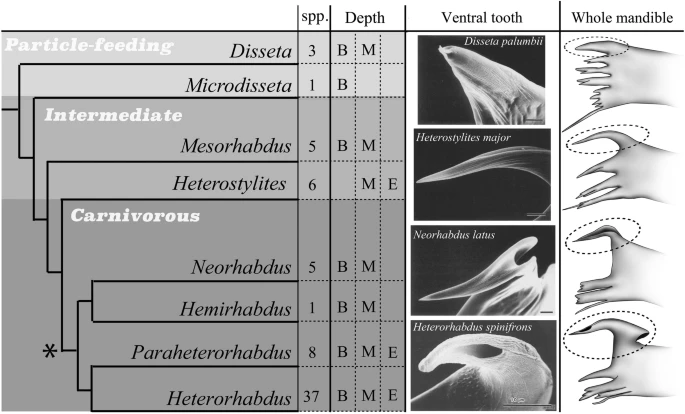
Tomonari Kaji’s team had a wonderful idea for an animal to examine this in. Most copepod crustaceans are peaceful particle-feeders, filtering tiny particles of food out of the water. However, there’s one group that have evolved to be predatory. These tiny crustaceans stab their prey with needle-like mouthparts, and it’s thought (but not yet conclusively proven) that they use their fangs to inject their prey with venom. Kaji and the scientists therefore compared the mouth structures on four crustaceans – the particle-feeding Disseta palumbii, the probably venomous Heterorhabdus subspinifrons and two which seem to be somewhere in the middle, Mesorhabdus gracilis and Heterostylites longicornis. The problem they faced was that all these animals are tiny and invisible to the naked eye. Even under a normal microscope you’d struggle to get a look at their tiny mouthparts, so the researchers had to resort to incredibly powerful state-of-the-art electron microscopes to take pictures.

They found that while the top of the mandible had evolved into a stabbing fang in the predatory and omnivorous copepods, most of the muscles were actually incredible similar across all four species. The probably venomous Heterorhabdus sunspinifrons had a single extra muscle, but that was the only difference in muscles the scientists found. They found more difference in chemical-producing glands, which varied slightly between all four species. However, in Heterorhabdus one of the glands was found in a very different position, at the top of the hollow fang, and much larger than in the other species. The researchers suggest that another type of gland, which appears to be activated by surrounding muscles when the copepod chews food, may also be important. This suggests a possible route for the emergence of venom – glands which evolved to release chemicals to help digest food while the animal chews (such as our own salivary glands) become repurposed to attack the food before it dies instead of after.

Different mouth shapes in Viper copepod crustaceans, grouped by feeding method. The tree on the left shows their phylogeny (evolutionary history), while the columns show the number of species in the genera and the depth at which they life – B is the deep (1km down) Bathypelgaic, E is for Epipelagic (i.e. on the surface) and M is for Mesopelagic, around 200-1000m below the surface

The researchers draw the most attention to the fact that the differences between the carnivorous and particle-feeding copepods are actually pretty small. Heterorhabdus has travelled furthest down the predatory road with its venom, but the omnivorous species also have fangs to help them catch and kill prey. The fact that the four species are so similar suggests that in these crustaceans, the switch to carnivory and then to ‘venom-assisted feeding’ needs only a few small changes in mouth shape and modifications to muscles. Importantly, the changes in mouth shape don’t necessarily require venom, and the researchers suggest a fairly straightforward route by which venom can evolve.

This study is also interesting from the point of view that the techniques used are old-fashioned comparative anatomy, but made possible by the latest advances in imaging technology. Genomics and Genetics may be marching on faster than most of us can keep up, but there’s clearly still a lot of life left in the old methods. It also goes to show how small changes can lead to big innovations which change the course of evolution. Who knows what these copepods will evolve into over the next few million years?

*I’ve not been following that particular area in the past couple of years, but last I heard the fashionable theory about this in birds was that underdeveloped wings, having evolved as a means of communication and display, are actually incredibly useful in navigating cluttered environments. Partridge chicks can help themselves run up very steep inclines by flapping their wings, even before they can fly.

If you find an error or lack of clarity in this piece, please contact me on j.d.r1612@gmail.com and I’ll fix it as soon as I am able

When does a bird decide to fly? Adventures in Flight Initiation Distance

From “Anti-predator behavior along elevational and latitudinal gradients in dark-eyed juncos”, M. Andrade, D.T. Blumstein (2019), Current Zoology zoz046

https://doi.org/10.1093/cz/zoz046

The vast majority of wild animals will, if a person walks towards them, run or fly away. For something so commonsense and easily taken for granted, this is actually quite poorly understood as a phenomenon. At what point does the animal decide to flee? What influences this decision? Would the same animal flee at the same point in all circumstances?

One way scientists have devised of investigating this is to train people to walk slowly, at half a metre per second, towards an animal. This allows scientists to measure the ‘Starting Distance’, when they first spotted the animal, the ‘Alert Distance’, the distance at which the animal begins to show alarm (e.g. by turning towards the experimenter) and finally the ‘Flight-Initiation Distance’ (FID) when the animal finally decides to flee. Madelin Andrade and Daniel Blumstein were interested mostly in the last one, and decided to experiment on dark-eyed juncos (Junco hyemalis), a sort of small brown or grey American sparrow.

There have been several other experiments on Flight-Initiation Distance (FID), which have yielded a variety of perplexing results. Animals flee sooner when they are in areas with more predators, near the nests of predators, further from safety and when they are approached faster. None of these are particularly surprising. However, social birds also flee sooner when in larger flocks, and species which are armoured or camouflaged tolerate experimenters getting nearer than unprotected species. Does this reflect some kind of awareness of their protection or does the armour just slow them down and the camouflage need stillness to work? Even odder is the apparent connection with latitude – animals in the tropics seem more flighty than those further north or south. This has been suggested to result from the fact that there are more predators in the tropics, but no certain explanation has been found.

Andrade and Blumstein were interested in how altitude affects FID. This was partly due to a well-known concept in ecology that altitude mirrors latitude – as you get further north or south it gets colder, and the same happens as you get higher up. Because of this, you get cold-adapted plants and animals in the far north and south, and also on the tops of mountains, and warm-adapted ones in valleys and the tropics. That said, there are differences – previous studies have found that birds faced more predation at higher altitudes, compared to less predation at higher latitudes.

The scientists set their carefully-trained volunteers on juncos in seven sites across California, collected data about the bird’s FIDs, and built statistical models to see which of the factors they were considering had the biggest effect on the birds’ FIDs. The aim of this was to get some indication of what made the birds decide to fly away at the particular point when they did. These factors were: Starting Distance (SD, how far away the researchers began to approach the birds from), elevation above sea level, the interactions between SD and elevation, latitude, the interactions between SD and latitude, and the number of predators the researchers encountered per hour.

They found that elevation – altitude – was important in explaining FID. Birds at higher elevations flew sooner, while those at lower elevations let the researchers get closer.* They also found that the interactions between SD and elevation appeared to play a role. So why would elevation affect how flighty the juncos are? It’s possible the birds living higher up are under more pressure from predators – that would agree with studies in other species of birds. However, Andrade and Blumstein did not find any connection between the number of predators spotted and the junco’s FIDs. They suggest that this may be because the number of predators spotted by researchers might not actually be a very good way of measuring how much pressure the predators are putting on the juncos. Another possible factor is that the birds living higher up live in a more stressful environment generally, with less and worse food, so they allow researchers to get closer rather than immediately use up scarce energy on flight. This may explain the apparent connection between elevation, FID and the researcher’s Starting Distance: lower down as the Starting Distance increases, so does the Flight-Initiation Distance. The further the researchers start from, the shorter the distance the birds are willing to tolerate them within. Presumably, as the researchers walk in a straight line, the further away they start from, the sooner the juncos realise that the researchers are heading towards them, rather than just passing by. Higher up, however, this relationship is weaker, perhaps suggesting the birds are more reluctant to move. It’s hard to reconcile the apparent contradiction between these two explanations, but it seems that the Starting Distance could be just as important as the Flight-Initiation Distance.

Which just goes to show how complex even the simplest of questions about the natural world, such as ‘what affects how soon a bird will fly when you approach it’ can become.

*This is the opposite of what happens with latitude

If you find an error or a lack of clarity in this piece, please don’t hesitate to contact me on j.d.r1612@gmail.com and I’ll fix it as soon as I am able.

How useful are bednets in preventing leishmaniasis?

From: “Effect of insecticide-treated bed nets on visceral leishmaniasis incidence in Bangladesh. A retrospective cohort analysis”, R. Chowdhury, V. Chowdhury, S. Faria, S. Akter, A.P. Dash, S.K. Bhattacharya, N.P. Maheswary, C. Bern, S. Akhter, J. Alvar, A. Kroeger, M. Boelaert, and Q. Banu (2019), PLoS Neglected Tropical Diseases 13:9

https://doi.org/10.1371/journal.pntd.0007724

The founding principle of public health is that prevention is better than cure. It might be expensive to build sewers to prevent cholera epidemics and provide vaccinations to ward off measles, but it is far better and cheaper than treating (or burying) people with those awful diseases. This does mean, however, that public health officials need to know how well different methods of prevention work, so they know what to invest in.

Visceral leishmaniasis (know in South Asia as kala-azar) is a particularly unpleasant disease, caused by a microscopic parasite known as Leishmania and spread by sandflies (Phlebotomus argentipes). It seems to have first arrived in what is now Bangladesh in around 1824, but was eradicated in the 1960s as a lucky side-effect of insecticide spraying designed to eradicate malaria: the insecticide killed both the malarial mosquitoes and the sandflies. However, within a few years, leishmaniasis had crept back in. In 2005 Bangladesh, India and Nepal launched a regional initiative with the World Health Organisation to reduce the number of cases to 1 per 10,000 people by 2015, later extended to 2020. With only a few months left, this target looks set to be missed, but impressive reductions in cases have been made.*

Traditionally, diseases carried by mosquitoes and sandflies have been controlled by spraying insecticide indoors, but in recent years the use of insecticide-treated bednets has become more common, which seems to work well against malaria. These nets are hung around beds, preventing flies from feeding on sleeping humans (and passing on diseases such as leishmaniasis) and killing those that try.  But how useful are bednets? Previous studies have found that they reduce the amount of sandflies found in houses, but failed to find any evidence that this reduced Leishmania infection rates. This seems to be because sandfly behaviour changed in response, causing more people to be bitten outside their houses.

To investigate this further, Rajib Chowdhury and their team looked at 15,871 households in Fulbaria, Bangladesh. This was a ‘retrospective cohort analysis’ looking at six groups which had been used in previous studies. Three of these had received insecticide-treated bednets in separate studies between 2004 and 2008, and three had not. This allowed the scientists to look at a much larger group of people than a single study ever could, giving them the statistical power to detect effects that smaller studies would not be able to find. Generally speaking, the bigger the number of people you’re looking at, the lower the chance that something unusual is happening with your group, and the easier it is to detect effects. 8 villages in 10 reporting a reduction in disease cases after your intervention could be a coincidence: 8000 in 10000 is probably not.

Of course, having been given a bednet does not guarantee that you will use it. However, 92.2% of households who had been given an insecticide-treated bednet still had at least one bednet, of which 80.1% were insecticide treated. That is, of 8142 households, 7509 had a bednet, and 6015 had an insecticide-treated bednet. All in all, 84.3% of households who had been given bednets claimed to be sleeping under them.

So, it seems that, by and large, those who had insecticide-treated bednets used them. What effect did this have on leishmaniasis? Three years after the studies, the infections rates had declined significantly in areas both with and without insecticide-treated bednets – but had declined far more in areas with the insecticide-treated nets. Before the introduction of bednets, there were 144 and 137 cases of leishmaniasis per 10,000 per year in the ‘intervention’ (given nets) and ‘control’ (netless) areas respectively. Three years later these numbers stood at 48 (intervention, given nets) and 108 (control, netless) per 10,000 per year. The authors calculate that the introduction of bednets reduced cases by 47%, compared with the areas without them.

Incidence (number of cases per 10,000 per year) of visceral leishmaniasis in Fulbaria upazila, Bangladesh, before and after the introduction of insecticide-treated bednets

This is not a watertight proof of the effectiveness of insecticide-treated bednets – there’s no such thing in epidemiology. Any study looking at this number of people over this many years going about their business can’t be as carefully controlled as a clinical trial. People being people, there’s always a chance that there’s something else going on you haven’t spotted, and you can never prove that everyone is using the bednets, for example. Nevertheless, this study is good, solid evidence in support of the idea that giving people insecticide-treated bednets in areas suffering from leishmaniasis is a very good idea.

*I did have a quick look on the WHO website, but wasn’t able to find up-to-date data on the numbers of leishmaniasis cases for these countries. The WHO does however still consider them all endemic for visceral leishmaniasis

If you find an error or lack of clarity in this piece, please do not hesitate to contact me at j.d.r1612@gmail.com and I’ll fix it as soon as I am able

Boating flies: how mosquitoes travel through the Amazon

From: “The genetic structure of Aedes aegypti populations is driven by boat traffic in the Peruvian Amazon”, S.A.J. Guagliardo, Y. Lee, A.A. Pierce, J. Wong, Y.Y. Chu, A.C. Morrison, H. Astete, B. Brosi, G. Vazquez-Prokopec, T.W. Scott, U. Kitron, S.T. Stoddard (2019), PLoS Neglected Tropical Diseases, 13:9

https://doi.org/10.1371/journal.pntd.0007552

The mosquito Aedes aegypti is a major agent in transmitting a wide variety of diseases, most significantly dengue, yellow fever and the Zika and Chikungunya viruses. Thought to have originated in Africa, Aedes aegypti appears to travelled to the Americas onboard ships trafficking in enslaved Africans.* Despite being eradicated from Peru in 1958, Aedes aegypti has made a comeback in Peru in recent decades, bringing dengue fever with it.

The Peruvian city of Iquitos, nestled in the Amazon rainforest, was the first place where Aedes aegypti was found to have re-established itself in Peru in 1984. Iquitos is an unusual city in the modern world, because it is only really accessible by plane and by boat. There is a highway leading to another Amazonian city, Nauta, but most journeys in this densely forested region are taken by boat, along the various rivers flowing into the Amazon.

Sarah Anne Guagliardo and her colleagues were interested in how Aedes aegypti spreads through this seemingly quite fragmented region. To test whether the local populations of this mosquito were very similar or genetically distinct (and therefore genetically isolated) to one another, they collected 339 mosquitoes from 4 areas of Iquitos and 6 nearby towns and cities. Using their DNA and some population genetics equations, they were able to estimate the amount of movement between the populations of Aedes aegypti in the various towns.

They found a fair amount of genetic differences, but none to suggest any great isolation – it seemed pretty clear that somehow, a few mosquitoes were moving around from place to place. The differences were big enough to suggest that great swarms of Aedes aegypti aren’t making their way through the rainforest from town to town, but small enough to suggest that mosquitoes were travelling quite large distances. What to make of this? Aedes aegypti has been known to travel on all kinds of vehicles, including staples of Peruvian transport such as buses and barges. The author’s previous work suggests that barges are particularly important for this, partly as the Aedes aegypti mosquitoes can lay their eggs in puddles on board the barges. In this study, they found that the populations of Aedes aegypti from the port district of Iquitos showed more evidence of genetic mixing with mosquitoes from outside of Iquitos than those from other areas of Iquitos. This, again, suggests that mosquitoes are travelling along the river, probably by boat. It should be noted at this point that it is unlikely that the mosquitoes are breeding and moving along the river itself – though they do lay eggs in water, they prefer still pools to fast-flowing rivers.

This is a very neat little study, nicely demonstrating how important humans and human networks are in influencing where other species end up. Humans, it seems, cannot live in isolation from nature, however hard we try.

*This happened a lot more than most people realise. Other notable introductions to the Americas from Africa courtesy of transatlantic slavery include malaria and yaws. I did a large part of my dissertation research on the transatlantic ecology of guinea worm, which was regularly shipped across the Atlantic inside enslaved Africans, and briefly established itself in the new world.

If you find an error or lack of clarity in this piece, please don’t hesitate to contact me on j.d.r1612@gmail.com and I’ll fix it as soon as I’m able.

Is there a downside to flight? Looking for trade-offs in bush-crickets

From: “Contrasting patterns  of  macroptery  in  Roesel’s  bush  cricket  Metrioptera  roeselii  (Orthoptera,  Ensifera)”, S. Szanyi, A. Nagy, I.A. Rácz, Z. Varga (2014), Estonian Journal of Ecology 63:4

doi: 10.3176/eco.2014.4.07

Click to access ecol-2014-4-299-311.pdf

Roesel’s bush-crickets (Metrioptera roeselii) have been presenting an interesting problem to scientists in recent years. Why? Because they have been expanding across Europe at a truly impressive pace. The first time I ever saw one was in Slimbridge, near Bristol, three or four years ago, but when I was in Dorset this August they were absolutely everywhere, in an area they definitely had not been only five years previously. They were so common, in fact, that I didn’t bother to get a good picture of one, but I’ve put my best effort below:

Roesel’s Bush-Cricket, brachypterous female, Durlston Country Park, Dorset (August 2019)

It’s still something of a mystery how they are managing to do so well and expand so fast. We can point the finger of suspicion at the usual suspects – habitat change and the ongoing climate crisis, which almost certainly contribute – but it is being speculated that these little crickets have a secret superpower which lets them conquer new turf. Normally, Roesel’s bush-crickets have fairly stubby little wings, which they use to produce a buzzing song (stridulation) and are good for little else, but under certain conditions,* their wings grow longer, beyond the length of the body, and develop fully. These long-winged crickets are called macropterous (ptera means wing, macro is big**) to distinguish them from the short-winged, brachypterous, form.*** It is thought (though not, to my knowledge, proven) that this long-winged macropterous form enables the crickets to fly off and colonise new habitat.

So why don’t all crickets have long wings, so any cricket can fly off and disperse if the conditions look right? This was what Szabolcs Szanyi and their colleagues were out to discover. Their theory ran like this: if there are no downsides to having long wings, all crickets would have them. Therefore there must be some trade-off somewhere. Having bigger wings means investing more energy in flight muscles. This means there is less energy to invest in reproductive organs, so long-winged Roesel’s bush-crickets will be less fertile. Which would explain why they are less common – long wings a disadvantageous trait to have in most circumstances, but not when the conditions allow individuals to colonise new ground.

To test this, the scientists did what anybody would’ve done: collect 410 crickets from six sites in Hungary and Ukraine, dry them out, and weigh them. At this point, a brief explanation about insect anatomy is needed. Insects are built in three segments: the head (contains: eyes, mouth, antennae, all you’d expect from a head, really), the thorax (where the wings and legs attach, in flying species contains powerful flight muscles), and the abdomen (which contains many important organs, including the reproductive organs). Broadly speaking, the scientists expected to find that long-winged Roesel’s bush-crickets were heavier than short-winged ones, due to needing more muscles in the thorax to power flight. This would mean that long-winged crickets had heavier thoraxes than short-winged ones. If the theory about trade-offs is true, the long-winged crickets would also have lighter abdomens than short-winged ones, as they could invest less energy in reproductive organs. Szanyi and colleagues expected that this would be particularly true in females, as the long-winged females would have grown fewer eggs.

It’s a beautiful theory.

Unfortunately, their results didn’t really support it. They did find that females were generally heavier than males, due to a heavier abdomen (where the eggs are stored pre-fertilisation). They did find that macropterous, long-winged, crickets had slightly heavier thoraxes. But they didn’t find any indication that there were any differences at all in the weight of the abdomen between long-winged and short-winged crickets.

Weights of long-winged (left) and short-winged (right) Roesel’s Bush-Crickets (Metrioptera roeselii), taken from Szanyi et al (2014)

It’s hard to know what to make of this. That long-winged crickets had, on average, heavier thoraxes due to their flight muscles makes sense. But it seems odd that this didn’t add up to an overall increase in average body weight while the average abdomen weights remained the same. But science isn’t always neat. Still, it’s refreshing to read a paper so open about not supporting its initial theory, and I’m looking forward to looking at this area some more.

*which, again, are not fully understood. Personally, my money’s on some connection to environmental temperature

**Biologists are very literal-minded people

***This also occurs in several other species of crickets, most confusingly the short-winged conehead. You can find short-winged coneheads with long wings. Which is one of several things that make figuring out if you’re looking at a short-winged conehead (Conocephalis dorsalis) or a long-winged conehead (a separate species, Conocephalis discolor) a major headache. This also appears to be an example of phenotypic plasticity, where the same genes, under different circumstances, produce very different traits, thus demonstrating that genes are not destiny, and poking a hole in some of the more straightjacketed approaches to population genetics.

If you find an error or lack of clarity in this piece, please don’t hesitate to contact me on j.d.r1612@gmail.com and I’ll fix it as soon as I’m able

Sex and Violence: The Surprising Consequences of Selective Breeding in Siamese Fighting Fish

From: ‘Artificial selection for male winners in the Siamese fighting fish Betta splendens correlates with high female aggression’, A. Ramos and D. Gonçalves (2019), Frontiers in Zoology 16:34

https://frontiersinzoology.biomedcentral.com/articles/10.1186/s12983-019-0333-x#Sec6

Differences between males and females (sexual dimorphisms) in animals are odd. Males and females have significant differences in their reproductive organs and hormone profiles, and in some species differences even extend to their behaviour (e.g. bull African Elephants are frequently solitary), colouration (e.g. blackbirds), size (female hawks are usually rather bigger than males) and even the presence or absence of entire features (only male Red Deer have antlers – this, however is not true of all deer species). In vertebrates, control mechanisms for all these differences must somehow be packed onto a single chromosome – not much genetic space for a lot of difference! *

A quick aside on humans. Sexual dimorphism in humans exists to an extent – men are generally taller, and far more likely to have facial hair, for example – but any consideration of this in humans faces a few problems. Firstly humans are very, very diverse, and any differences you find in one group of people may not exist in a different group. Related to this, it is extremely difficult to disentangle the multi-layered and interacting effects that sex (biological) and gender (social) have on a person – you just can’t do good nature vs nurture experiments in humans, especially considering how much the human body and brain is shaped by interactions with other humans. Thirdly, such differences as are alleged to exist are usually tiny and of no use at an individual level. Say Manchester City fans, broadly, prefer salt and vinegar crisps. The fact that Brian is a City fan does not mean that he is certain to even like salt and vinegar. Likewise, a heterosexual man saying “my blind date will be shorter than me” may be right more often than not,** but on any given blind date may well be wrong. Science has a shameful history of using ‘biological’ theories to enforce and excuse gender and racial discrimination and norms, and while research investigating anything is valuable, researchers need to thoroughly examine what assumptions they are carrying into it. Doctors were able to find entirely imaginary evidence that women and BME people were inferior simply because they could not believe that there was none to be found. As this is not an area in which I have any great expertise, I shall say no more. ***

But fish do not, as far as we know, have genders, so here at least, we are on fairly safe ground to discuss differences between sexes and the genetics involved. In south-east Asia, Siamese Fighting Fish (Betta splendens; Siam is usually another name for Thailand) have been selectively bred for aggression and fighting skills. Only the males are used in fights, so this not only provides an opportunity to see how much of an impact 600 years of artificial evolution has had on the fish, it also allows us to see if this artificial selection has had different impacts on the two different sexes. To do this, Ramos and Gonçalves compared a group of domestic fighting fish to their wild counterparts of the same species, using other fish and mirrors to trigger aggressive behaviours, and using the glass of the tank as comparisons for normal behaviours.

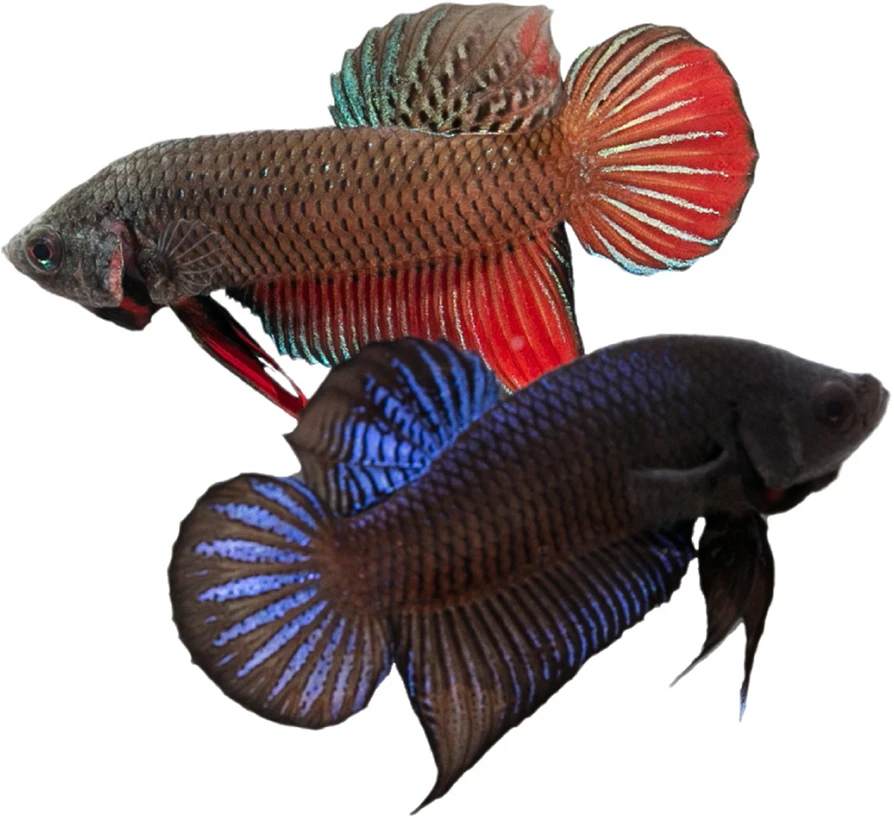
Siamese Fighting Fish, Betta splendens. The wild-type is shown at the top, and the domestic fighting type is below

Though most of the differences they found were fairly small, fighter fish were far more aggressive than wild fish across both sexes. In both wild and domestic fish, the males were more aggressive, but female fighter fish were more aggressive than female wild-type fish**** by a similar margin to that found between male fighter and wild-type fish. Moreover, the scientists found that in 10 sibling pairs, the more aggressive the male was, the more aggressive his sisters were. This suggests that whatever genes the breeders have encouraged in male fighting fish also increase the aggression of female fighting fish. Interestingly, fighting fish also approached challenges differently to wild-type fish: they kept their distance more, darted around more and displayed more. The authors speculate that in a tight, tall and open fighting tank, this behaviour allows the fish to stay near the surface and block their opponent’s route to the surface. Over several hours, this may deprive their opponent of air, giving the fish near the surface an advantage.

It is not clear exactly how artificial selection has changed the fishes’ behaviour, or whether the increased aggression in females is entirely due to the selection on males rather than some other effect of captivity. Perhaps more aggressive females survive better in tightly packed tanks? It seems likely that the selection on males has affected some genes important in modulating aggression across both sexes, but it has not yet been conclusively proved, and the evidence in other species is mixed. Selection for female aggression does not seem to affect male aggression in fruit flies or mice, but the same hormones (androgen and testosterone) seem to influence aggression across sexes in birds and fish.

There’s still a lot left to understand, but this study provides an interesting insight into how artificial selection by humans can influence the course of evolution, sometimes in very unexpected ways.

*many insects operate sex on an entirely different, and very fascinating, genetic system known as haplodiploidy, which you can look up if you like

**unless he’s unusually short, of course

*** But see M.F. Weiner and M. Hough, Sex, Sickness and Slavery: Illness in the Antebellum South for authors who are experts, as well as A. Saini, Inferior: How Science Got Women Wrong and the New Research That’s Rewriting the Story and Superior: The Return of Race Science

**** ‘wild-type’ generally is Biologist slang for ‘normal’, but in this case it literally refers to the type you get in the wild

If you find an error or lack of clarity in this article, please don’t hesitate to contact me on j.d.r1612@gmail.com and I’ll fix it as soon as I’m able

Design a site like this with WordPress.com
Get started